Thursday, February 3, 2022

Three Subsystems For Things You Already Have Subsystems For

Presented in order of confidence, most to least.

RESTY HITPOINTS

Here's a system for HP I've been screwing around with for a little while. (As usual, dS is "dice size," so +1 dS changes a d4 to a d6, and -2 dS changes a d12 to a d8.) This is mostly stolen from Jared Sinclair's 6e.

When you sleep, roll [level]dX. If the new total is higher than your previous HP, that's now your current HP. Resting will never lower your HP.

By default, dX is a d8. Here's what can change that:
  • -1 dS for each of the following: you go to sleep while...
    • wet
    • cold
    • exposed
    • hungry
    • thirsty
    • sick
    • in your armor
    • without a bedroll
    • seriously wounded (like, from a death & dismemberment table, not just regular combat damage)
  • +1 dS for each of the following: you go to sleep while...
    • having just finished a hot meal
    • in a real, actual bed
    • freshly cleaned and groomed
Max dX is a d20; min dX is a d1.

WHY THIS IS COOL

All that camping shit players love to ignore really matters. You need a bedroll, and a tent, and a mess kit, and a fire, and clean water, and a place to actually fucking sleep. On the flipside, buying a room and meal and bath is suddenly extremely worth it, because it's the quickest way to get back all your HP.

Imagine, for a second, the level 3 adventurer that just crawled out of the sewer-dungeon after having their gear stolen by frogpeople: they're wet, cold, and hungry. That's a d2, meaning until they can find a good place to sleep, their new maximum HP is a big ol' 6. 

By contrast, imagine that same adventurer spending a night at the inn in town: they're warm, they're fed, and they took a bath with real soap. Their die is a d20, meaning their max is 60 HP. Which, you know, is ludicrous, but that'll take months or years of resting to reach (because, remember, it's not additive—new HP only increases if it's higher than the old).

I also like this because it captures the "resting for longer is good and necessary sometimes" thing that Grit & Flesh does without needing to mess around with secondary HP tracks. 

INVENTORY EXHAUSTION

Here's an inventory-exhaustion system I've been screwing around with for a while. This is mostly stolen from Grave and Boots Full of Mud.  

You've got your inventory slots, yeah? Use those. (You might want to give players a few more than normal—I usually do CON + STR these days.)

Whenever you take a point of exhaustion, fill one inventory slot. If you end up with more filled slots than you have inventory space, you start slowing down and eventually can't move anymore.

Here are some things that mean you take a point of exhaustion:
  • Crossing a gradient line of elevation (cf. Boots)
  • Crossing a river
  • Traveling every hour past the normal daily amount (usually 8 hours)
  • Traveling a watch (4 hours) at a faster pace than normal (usually +1 mph)
  • Staying up for a watch (4 hours) when you should be sleeping.
  • Exhaustion-attacks and certain illnesses, like plague bugs or whatever
  • Pulling a stunt and an attack on the same turn in combat (cf. Grave, basically imagine baby's first Action Surge)
  • If you're playing 5e, have things that normally deal 1 Exhaustion (zerker's frenzy, for example) deal 1d4 slots or 1d6 slots or something
If you're using my resty HP, clear exhaustion every night equal to highest single die rolled. 

WHY THIS IS COOL

It makes exhaustion this extremely palpable thing that suddenly really matters, but also doesn't involve fucking around with either your HP or some additional track. It bites you where it hurts, but it's easy to predict. If your players are paying attention and managing their travels well, they'll be fine; if they get lost or lose their focus, they'll suddenly have no inventory to work with and that sucks big time.

If you use the stunt-exhaustion thing from Grave, which I like, it also means you get a cool Thief / Fighter distinction solely based on inventory: thieves wear light armor and carry light weapons so they can do lots of cool stunts in combat; fighters wear heavy armor and carry heavy weapons so they're more reliable, but every stunt they pull matters a lot more.

It's also just very... hackable. Modular. It's dead simple to add in more effects that inflict exhaustion, or have magical healing clear exhaustion, or whatver else.
 

CALLED SHOTS ONLY

This is a weird one. It doesn't play nice with resty HP, since it doesn't actually use HP (lol). Entirely untested.

Use your sandwich AC for attacks, where you've got to roll equal-to-or-under your attack stat but over your opponent's AC to hit. 

Every time you attack your opponent, say where you try hit them: torso, a limb, their head, or whatever. 

Their AC changes based on where you hit them:
  • Torso: +0
  • Limbs: +3
  • Head or neck: +5
  • Smaller specific part, like eyes or hands: +10
Here's what armor adds:
  • Leather, +2 AC
  • Chain, +4 AC
  • Plate, +6 AC
  • Dragonscale, +12 AC
The armor your opponent wears only covers so much. A breastplate protects only the torso. A helmet protects the head, but almost never the eyes. There's a constant dance of figuring out where the best place to hit them is.

If your attack is equal to or 1 more than their AC, it's a graze. A glancing blow. Cuts, scrapes, bruises.
If your attack is 2 or more than their AC, it's a hit. A solid strike, it'll do damage. Broken bones, flesh wounds, serious injuries.
If your attack is 5 or more than their AC, it's a critical hit. Severed limbs, crushed rib cages, heads rent in twain. 

There's no HP here, just diegetic damage. If something would kill someone, it kills them. Bear in mind that a graze to, say, the eyeballs is going to do a hell of a lot more than a graze to the ribs.

WHY THIS IS COOL

There's a dance to every fight. Imagine my opponent: they've got a breastplate, leather gauntlets and greaves, and a chainmail coif. If I attack their torso, their AC's about 4. Decent odds for me, but even a solid hit is not guaranteed to knock them out of the fight. If I attack their head, their AC's about 9, but even a graze will do serious damage. If I attack their sword-arm, their AC's about 5, and a solid hit will seriously dampen their ability to hit me. 

It means that every swing in combat is a gamble, a decision. It probably does slow each turn of combat down, but it means each turn can potentially end the fight. There's no whittling-down of HP real slowly until the monster drops dead—you either kill them, or you don't.

It also means you can make combat into more of a puzzle. Take a dragon: its weak spots are its eyes, its mouth, and whatever hole it has in its diamond belly-armor. Those are hard to hit, but are always going to be easier—and deadlier, probably—than trying to punch through dragonscale. 

Again, this is completely untested, but it's my hope, my suspicion, that this kind of system enables combat to be less about cronching numbers against each other and more about figuring out ways to exploit your opponents' weaknesses. Hopefully.

--

Let me know what you think.

Sunday, January 2, 2022

1d50 Things I Learned in 2021

An end-of-year retrospective, in no particular order.
  1. Trying to match colors across Photoshop and InDesign after the fact is a nightmare. Write your color codes down early, in CMYK, then stick to them across both.
  2. Mixam's page cuts are not that equal, even from page to page: what you put in the bleed genuinely does matter, even if it seems like it doesn't.
  3. Picking two or three colors (one of which can/should be black or white) as your page background, main body text color, and spot color is a very cheap and easy way to make your basic PDF stand out.
  4. In New York, unless you 100% absolutely for-sure positively know it'll be amazing and worth it, never pay more than $1 per slice of pizza.
  5. Good game text is what keeps people playing your game, but good presentation and artwork is what gets them to start at all.
  6. Almost every RPG written by beginners (mine included) is over-written. Most paragraphs can be sentences. Many sentences can be cut. Never explain anything just to explain it.
  7. Relatedly, almost all indie RPG designers (like other indie game designers, to some extent) are writing for a niche crowd that has already played RPGs. Yes, your game might be played by your mom who's a total newbie, but the person running/facilitating that random tiny indie game has read and played fifty other RPGs. Stop explaining what an RPG is.
  8. A monster that normally talks but suddenly can't is spooky. A monster that normally can't say a word but suddenly starts talking is terrifying. (Did you know ghouls can talk in most systems?)
  9. As a broad rule of thumb: wizards that travel = good; wizards that stay in one place = evil. 
  10. Unless you have the same person doing writing and layout, make sure your writing is entirely done before you go to layout.
  11. International shipping is crazy expensive. Budget at least 1.5 times what you think you should for it.
  12. Inform 7, the interactive fiction tool, is a rough ride. Parser games in general are rough.
  13. Maps are always useful. I've never looked at a map that came with my RPG and said "nah, this is useless." High-quality maps are among my most-used and most-prized RPG tools. (Top of the list currently are kahva's topographical maps and Tim Denee's Doskvol street maps.)
  14. Languages in RPGs are deeply under-explored, and people are eager and excited to use them more. Not in the sense that we need more fantasy languages, but we need new and interesting ways to use language, on a mechanical and roleplaying level.
  15. I hate reading paragraphs in RPGs. Maybe I'm just spoiled with Mosh and Mork Borg and slim little hacks, but I'm just so tired of opening up an adventure or system and just seeing paragraphs and paragraphs of text.
  16. Putting player characters in positions of power—lords, elders, commanders, cult leaders, presidents—is a good way to give them agency. Even in a system where, on paper, all power lies with the GM, giving the player characters lots of in-fiction power is a good way to get them impacting the game in big ways. 
  17. Lots and lots of "generators" in RPGs are less-than-helpful. I want a step-by-step instruction list or a mad libs fill-in-the-blank or a worksheet. Give me something I can like, fill out for my game. Stop making me do all the legwork. 
  18. Use your good ideas first; don't save your good ideas for later down the line. You'll always have more good ideas, so don't hold out on the good shit early.
  19. Editors are fucking amazing. I've only hired a couple, but every time I've gotten an outside editor to look at my work, it's improved many times over.
  20. Bigger is always cooler. A dire bear that's 22 feet tall? Cool. A dire bear that's 75 feet tall? Rad. A dire bear that's 450 feet tall? Fucking awesome.
  21. College and university campuses are a very useful scale for thinking about medieval / fantasy cities. Walkable, and small enough you can walk from one end to the other in half an hour or less—but you also will never see inside every building, nor will you ever meet every person. 
  22. There's no substitute for legwork. Legwork on the part of the designer—making maps, stocking dungeons, writing out descriptions for things, actually doing the work—is what makes RPG projects actually good. Stop giving me seeds of adventures and actually spell out the adventure for me.
  23. Unless your game is actually going to be in brick-and-mortar stores, back-of-the-book text is useless. Put another table or a quick reference or something on there instead. 
  24. I sort of knew this already, but I still feel like I'm processing it: in terms of dice, multiplication is slower than subtraction which is slower than addition which is slower than comparison. It's faster to pick the highest of 2d6 than it is to add 2d6 together.
  25. I listen to more Spotify than anyone else I know.
  26. If you can't pick a font, start with one of Vignelli's six and figure it out later.
  27. Trying to make tables in multiple layers, with the lines on one layer and the text on another, is a giant pain in the ass but also lets you do some very cool things with weathering and distressing and stuff.
  28. In both RPGs and video games, it's easier to mimic physical action than anything else. Give your players tools to jump, swim, fly, leap, swing, zoom, merge, and so on. 
  29. When you make a Kickstarter thumbnail, keep it simple: big text, big image, bold colors. Too many look cluttered, and that's bad.
  30. There's something a little ineffable that emerges with longer campaigns. A campaign that lasts one session feels different than three sessions, which feels different than 12, which feels different than 50, which feels different than 200. I find myself wanting to run longer ones more often.
  31. Reading before bed is absolutely cracked. Just overpowered as fuck. Reading for 30 minutes and sleeping for 7.5 hours makes me feel better than sleeping for 8. Just busted as hell.
  32. Sean McCoy's paragraph < list < table < diagram < illustration hierarchy is really, really good. 
  33. Turns out the key to making good french toast is to add a little vanilla extract and cinnamon to your egg + milk, then let the bread sit in there for longer than it feels like you should. You want the bread almost fragmenting; instead of fishing it out of the bowl with a fork, use your spatula and tilt the bowl so you can lift the whole thing out. The more milk + egg your bread soaks up, the juicier and fluffier the toast will be, and the better it will taste. And really, it's almost impossible to overdo the vanilla and cinnamon.
  34. Watercolor brushes in Photoshop are a really good way to add just a smidgen of texture to a page background, or to any illustration. Slightly offset the color (usually a touch darker) and just paint over your main body color.
  35. The RPG space is a bizarre cottage industry. Relative to other creative fields, there's no distribution, no publishers, no networks, no pipelines. Just like ten thousand enthusiasts trying to do everything themselves. I have no idea how to fix this, but it's an issue.
  36. Everything they talk about on Trying To Be Kind. Killer podcast.
  37. Undead are way scarier when they're something you saw when it was alive. A corpse in a dungeon that sits up is a little spooky; a goblin that you definitely kill and then sits up anyways is way more alarming.
  38. I'm tired of "TV Show X, but as a game!" Both in the official licensed sense and in the "strongly inspired by" sense. 
  39. The existence of Morton's List, the game written by an on-again-off-again ICP member that was banned from GenCon and is essentially Crime: The Game. Truly a wild time.
  40. Many dungeons don't need to be on grids. Flowcharts work fine. (Unless your players will be doing a lot of digging / warping through walls.)
  41. Subsection headers can be written as [Page #].[Subsection #]: so subsection 4 on page 16 would be 16.4. Mosh does this, it's not hard, it's easy to reference, it looks very cool.
  42. GM screens are a nightmare to make. Do not try to make them unless you somehow have a printing industry connection the rest of us don't.
  43. K6BD rocks. Turns out everyone saying it rocks for years was right.
  44. Secrets are a good way to make macguffins interesting. A magic rock is boring. A magic rock that has to be kept secret because otherwise the Inquisition will be after you is suddenly very fun. Players having to decide who they can trust is always good.
  45. A 100-foot cliff is a challenge for low-level players. A 1,000-foot cliff is a challenge for mid-level players. A 10,000-foot cliff is a challenge for high-level players. A 100,000-foot cliff is a challenge for anyone. (For 5e players, consider adding an additional 0 to each.)
  46. Tinfoil hat on: system design is prevalent because systems are a means for the designer to directly influence the game; content is meant to be changed and thus does not allow the same level of authorial control. System design is, on some level, an authorial power trip (also supported by all of WOTC and their marketing team).
  47. Brutalism is rad. I'm a fan.
  48. Random encounters in dungeons and wilderness zones are time pressure: more time in the dungeon means more chances of encounters means more chances of death. Move fast and you're less likely to die. Time pressure's often lacking in RPGs, and is usually good.
  49. One of the best ways to learn layout is by trying to mimic existing RPG material. I learned a ton from trying to make my own Blades, 5e, and Mosh character sheets.
  50. There's a difference in "system" between mechanical game-system and diegetic world-system. If I say "food is currency," that is a mechanical game-system, since you like pay for goods and stuff with food and thus there are some complicated currency-per-day systems, but! it's mostly a diegetic world-system. The people in this world use food as currency: the emergent behaviors from that rule make the game rich and interesting, because it's rooted in the world itself.
There were, obviously, more things I learned this year. But this is good enough for now. 

Wednesday, December 1, 2021

Greater America

THE PITCH

It's a road-tripping campaign set in the late '90s. You start somewhere on the East Coast, New York or DC or Boston, and have to go west.

It starts out normal enough. You pile into the station wagon starter vehicle, load up all your gear and crap (250 inventory slots!), buy gas and food, and count up your last precious dollars (currently $389 across all four party members).

You take the I-90 West. 2 hours to Albany, another 2 to Syracuse, another 3 to Buffalo. You decide to push on another 3 to make it Cleveland. You pay $60 for a motel with two queen beds; there are some fanfic jokes, and you decide two of you will sleep on the floor. It's another $45-odd for gas, and $20 for road snacks.

Next morning, it's 5 and a half hours to just south of Chicago, where I-90 turns into I-80 and keeps going west. 4 and a half hours from there to Des Moines, where spend $55 on a motel room with shittier art. Another $40 for gas; you splurge and go to a diner, spending $30 on a huge breakfast for all of you.

It's 2 hours to Omaha; mid-morning by the time you leave.

You see the sign, same as all the others:
Thanks for visiting IOWA!
Then, you see the next sign;
The state of WINNEMAC welcomes you!
What?

You keep driving. Maybe it was a joke?

Then you see the license plates: WINNEMAC, they say, "The Barley State."

After 20 minutes of driving, you pull off I-80 into the town of Cooley, WM. Population: 4,302; ZIP code: 24519. It's a normal farm-country town: couple of gas stations, a post office, town hall, a handful of strip malls. They've got a Starbucks and a BK, but they explain the nearest Walmart is a couple of towns over, in Nadleville.

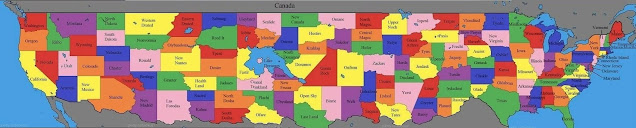
Eventually, you notice the flags: they've got a lot of stars. A lot of stars. Same ol' 13 stripes, but dozens more stars than the normal 50.

You buy a map. It looks something like this:


--

A CAMPAIGN IN GREATER AMERICA

It's a modern-ish campaign, as much or as little magic as you'd like, but set in an impossibly-large United States. It's some 10,000 miles to get from coast to coast, and you all now find yourselves as strangers in a strange land. 

Except it's not actually a strange land. They still get CNN, you can still buy a Coke, they still drive Fords. There's just... more. More states, more land, more mountains, more people, more.

As GM, you are of course welcome to populate the now-vast interior of the US with whatever you please. Bizarre roadside attractions, strange NPCs, the wear & tear of long-distance travel, dungeons hidden in shopping malls—the works.

The main difference now is that your players won't know all of it. Every new state line is a mystery; every new highway is unfamiliar.

--

1D100 MORE STATES

  1. Jefferson (JF)
  2. Greyter (GT)
  3. Fargo (FG)
  4. Tates (TS)
  5. Raxlan (RX)
  6. Green Rock (GR)
  7. Doramos (DO)
  8. New Nantes (NN)
  9. New Madrid (MR)
  10. Bestings (BE)
  11. Shandle (SH)
  12. Trimeda (TR)
  13. Las Forodas (LF)
  14. Columbia (CM)
  15. Delmarva (DM)
  16. Absaroka (AB)
  17. Sequoyah (SQ)
  18. Cumberland (CU)
  19. Lincoln (LN)
  20. Kinney (KI)
  21. Madawaska (MW)
  22. Westmoreland (WL)
  23. Cascadia (CS)
  24. Van Zandt (VZ)
  25. Franklin (FR)
  26. Dade (DA)
  27. Acadia (AC)
  28. Elizabeth (EZ)
  29. Yazoo (YZ)
  30. New Holland (NO)
  31. Gwinnett (GW)
  32. Pinckney (PY)
  33. Sawyer (SY)
  34. Roberdeau (RO)
  35. Randolph (RD)
  36. Fremont (FE)
  37. Winnemac (WM)
  38. Keystone (KS)
  39. Ambarino (AM)
  40. LeMoyne (LM)
  41. Disraeli (DI)
  42. Mercer (MC)
  43. Tristana (TR)
  44. Guarna (GU)
  45. Barona (BR)
  46. Pawtucket (PW)
  47. Mucklewam (MU)
  48. Pala (PL)
  49. New Tyne (NT)
  50. Brigham (BG)
  51. Clingan (CI)
  52. Spaight (SP)
  53. Boerum (BM)
  54. Wolcott (WO)
  55. Tilghman (TI)
  56. Ynez Island (YI)
  57. Seneca (SE)
  58. Soboba (AB)
  59. Tuscarora (TU)
  60. Kingsland (KL)
  61. Wyandotte (WD)
  62. Jackson (JS)
  63. Habamotalel (HB)
  64. Augustine (AU)
  65. Cazneau (CZ)
  66. Fuller (FU)
  67. Hugueiana (HG)
  68. New Flanders (NF)
  69. Aghaboe (AG)
  70. Saragossa (SG)
  71. Hesselblad (HS)
  72. Coushatta (CH)
  73. Lagoverde (LV)
  74. Jennings (JN)
  75. Beveridge (BV)
  76. Knox (KX)
  77. Ostend (OS)
  78. Kickapoo (KP)
  79. Odawa (OD)
  80. Manzanita (MZ)
  81. Nansemond (NA)
  82. Passamaquoddy (PM)
  83. Quinault (QU)
  84. Walacasco (WC)
  85. Marchant (MH)
  86. New Sicily (NS)
  87. Calisota (CL)
  88. Ames (AE)
  89. Mickewa (MK)
  90. Oconee (OC)
  91. Tippecanoe (TC)
  92. Boone (BN)
  93. Ventnor (VN)
  94. Lyndon (LY)
  95. Cyrenia (CY)
  96. Ephesia (EP)
  97. Claviers (CV)
  98. Hacklesbad (HC)
  99. DeWhett (DW)
  100. Dyer (DY)
A lot of these names—like real US states—come from indigenous American Indian tribe names. If you live in the States, please donate to your local American Indian rights groups and organizations.

--

APPENDIX N

  • All Gas No Brakes, now Channel 5 News with Andrew Callaghan
  • Grand Theft Auto, particularly San Andreas and V
  • Kentucky Route Zero
  • Overland
  • That road trip I took with my friends back in the summer of 2018

Thursday, November 11, 2021

Slush Pile 11.21

In the style of Throne of Salt.

#

CRUNCHY-ASS ARMOR

Armor has a single stat attached to it, called "Armor Value," or AV, which ranges from 1–6 (usually). 

When a weapon's damage roll equal the armor's AV, the damage is negated. That means if you roll a 4 on damage against an AV 4 target, they take no damage.

Here's a sample AV chart:
  • AV 1: padded cloth
  • AV 2: quilted coat
  • AV 3: leather gambeson
  • AV 4: lamellar armor
  • AV 5: chainmail
  • AV 6: full plate
Critically, you can wear multiple kinds of armor. However, you can only wear 3 armors at once, and those three cannot be fully contiguous. AV 1 / AV 2 / AV 4 is fine, or AV 2 / AV 3 / AV 6, but not AV 4 / AV 5 / AV 6. 

Armor takes slots equal to the highest AV, +1 for each additional armor. (Plate, chainmail, and a quilted coat takes 8 slots.)

Bladed weapons deal 1d4 + 2 (dagger) // 1d4 + 2 and 1d4 + 2 (longsword) // 1d4 + 2 and 1d4 + 2 and 1d4 + 2 (greatsword). 

Blunt weapons deal 2d3 (cosh) // 4d3 (hammer) // 5d3 (big hammer) // 6d3 (maul).

Stabby weapons deal 1d6 (arrow) // 2d6 (spear) // 3d6 (pike).

#

SPEAK NOT THE NAME OF THE BROWN ONE

a brown one

Don't speak the name of the brown one. It will summon him. 

Honey-eater, tree-climber, fish-hunter, man-killer. All are the brown one.

The brown one is a god amongst men: as we do not say the names of the gods, we do not say the name of the brown one.

If you wish to face the gods early, speak the name of the brown one. It will summon him.

#

DELTA HUNGER

Within the heart of every living person lies a primordial desire, buried beneath a hundred generations of civilization and a lifetime's worth of training.

This desire is beneath shelter, beneath safety, beneath sex. It is the desire to eat. To devour. To take a living thing and consume its strength. To feed.

(0) Appetite
Eat someone. Enjoy the taste.
You can eat raw meat without penalties or danger.

(1) Hunt
Kill someone. Eat them. 
You can drink blood like it was water, and eat meat like it was bread. You learn the spots to hold on someone's neck to squeeze the life out of them like juice. You grow broad in the shoulders.

(1) Palette
Go a week eating nothing but human flesh.
You can eat an entire person in one sitting, and it will feed you for a month; you won't need to eat or drink anything else. You grow thick around the middle.

(2) Grind
Bake bread from someone's bones: use the marrow for water, ground bone powder for flour, and the bones themselves as coal for the oven.
You grow strong, strong enough to snap someone's bones with your bare hands. You can sling a thrashing person over each shoulder and carry them both without issues. Your thighs, upper arms, and neck grow heavy and muscular.

(2) Pantry
Keep someone alive for at least a week, eating a new part of them every day.
You can smell when someone's afraid, even if they're hiding it. You can smell fear from up to a quarter-mile away. You grow tall, more than seven feet, rolling with muscle and fat.

(3) Butcher
TBD
Something about preserving people for a while

#

TOWER OF BABYLON ANTI-DEPTHCRAWL

Stolen from Ted Chiang.

Based on the math he gives us, the tower's about 50 miles high. The radius of the tower is between 5.5 and 6 miles: with a full day's walk, a person climbs roughly one vertical mile each day.

The base of the tower is all construction; the lower tower is crops and plants to feed the builders; the middle of the tower is sun-baked; the upper tower is more construction villages and hanging gardens; the top of the tower is near the dome of the sky.

Make a d150 table, roll a d50 on it every day, and add your current height in miles. The very bottom is all builders, the middle is encounters and birds and things, the top is angels and mystics.

#

LESSONS FROM THE MICRO-MEGADUNGEON

Things I learned from running the earliest version of Beneath Harlowe House:
  1. Make it dense and tight. When you think your hallways are narrow enough, make them even narrower. Compress vertically: lower ceilings, collapse upper levels, make them crawl on their bellies. Make them lose sight of each other around corners.
  2. Get them lost. Make them draw their own maps, and have passageways twist and wind. Being underground because you're looking for money is bad: being underground because you literally can't find your way out is terrifying. (Also, the elation of having your map-guesswork suddenly be correct is a joy for players.)
  3. Scarier is better, but this doesn't need to be complicated. They'll have to start leaving certain pathways unexplored if they want to reach the bottom: play on those fears. Have strange noises echo throughout. Have monsters leave "offerings" in places they know the players have gone. Leave clear evidence that they're being followed. Don't show the monster until it's ready.
  4. Embrace the physicality. What are they wearing? How much space do their packs take up? Can you fit a sword in there? How thick is this wall? When they lost that lantern, where did it roll to? What's the ceiling made of? 
  5. Leave it voluntary. If the campaign says "they must go into the spooky hole because the Sword of Flour & Flame is down there," players know they have to. If the players say "let's go into the spooky hole" even though they know they don't have to, it means they might actually fucking die.
  6. Slow burn. For the first two sessions of Harlowe, my players didn't even see a monster. When they finally saw one, it was only because Phlox's character stayed outside after dark—and even then, it was just indistinct, elongated scuttling.
  7. Multiple trips. It's fine if they want to leave and come back
  8. Actual impact. Let them dig new tunnels, if they want to take the time. Remember thine hourly encounter rolls.
  9. A sudden trapdoor is fucking terrifying. If one character unexpectedly drops down two levels into the dark, and now they're almost out of HP, and they can hear monsters coming, players lose their fucking shit.

#

CHARACTER CONCEPTION vs. CHARACTER PERCEPTION

5e players hate rolling stats.

When you set out to play an RPG, you often have some kind of character conception: an idea of who you want your character to be, how they'll behave, where they end up. This conception more or less never survives contact with the table.

At the table, you only have a character perception: the gathered info on how your character actually behaves in practice, what character traits they literally show in play.

Dissonance between these—how you imagine your character to behave vs how they actually behave—usually annoys players.

OSR games try to deliberately break you of any conception by rolling for stats, rolling for history, rolling for random trinkets or quirks or whatever. You know ahead of time you can't conceive of a character because the chargen process is so non-player-determined.

5e, culturally, embraces character conceptions, though. And so 5e players hate rolling stats. 

#

ALL ONE STAT

You have one stat: stamina. It starts at 10. 

When you make a check, roll 1d20 under stamina. You have inventory slots equal to stamina. Your speed in feet is equal to stamina times 3. When you take damage, you lose stamina. 

Every full day you spend resting, roll 1d20: if it's higher than your current stamina, now that's your stamina. 

If you reach 0 stamina, you die.

#

RITUAL MAGIC TRADITIONS

magical traditions in the style of my slow ritual magic: each tradition has its own sites, trappings, and performances. Necromancy uses full moons, anatomy textbooks, and ritual removal of organs; pyromancy uses the noonday sun, burnt incense, and ceremonial salt-burning. 

Go one step further: each spell has its own list of sites / trappings / performances, but there are some overlaps between them. "Illusion spells" are only a tradition because most of them happen to share foggy days, steel wool, and spinning of veils as their sites, trappings, and performances.

This is just a fuckload of legwork for a designer to build, though.

#

LANGUAGES AS SPELL LISTS

Different spell lists based on the languages you speak. Draconic gets you fireball and flight and fear. Deep gets you tentacles and telepathy and water-breathing. Terran gets you earthbind and wall of stone and whatever else.

Tie the number of languages you know to your Intelligence. A more powerful age is a more Intelligent mage not because their spell save DC scales off of INT or whatever, but because they literally know more spells and thus can combo them in interesting ways.

#


More to come, eventually.

Tuesday, October 26, 2021

How To Do ZineQuest: A Step-by-Step Guide

ZineQuest 4 is just around the corner: this is a guide about how to launch a project for it and then see it through to the end. (What is ZineQuest?)

As a quick note—this is going to be fairly US-centric, as that's where my experience lies. I expect printing and production costs will hold similar-ish, but shipping will vary a whole lot. Apologies to the international readers; I hope you can find some value in this regardless.

This is a pretty mammoth post. There's an executive summary at the end. Strap in.

WHY ZQ?

Why make a project for ZineQuest? The short answer is because:
  • It can make you a (small) profit
  • Having published projects people can hold in their hands is good for clout
  • It's a lower-stakes way to learn the ropes of RPG production
  • It's (sometimes) fun!
Obviously, neither RPG publishing nor Kickstarter are for everyone. There are lots of good reasons to do neither. But I assume, if you're reading this, that you're interested in Kickstarter and publishing RPGs, so we're going to proceed as if you've already made up your mind.

STEP 1: THE ZINE ITSELF

Traditionally, the requirements for ZQ projects were as follows:
  • It must be 5.5" x 8.5"
  • It must be saddle-stitched (stapled) or unbound
  • It must be 48 pages or less
  • It must be in 2 colors (typically one paper, one ink)
Following the rules means that your project gets by Kickstarter staff as "ZineQuest," and so when people come to the site and click the big scrolling ZINE QUEST ZINE QUEST ZINE QUEST banner, they'll see your project. 

In practice, however, these rules are not really enforced; if your project hits 2/4ish of those, you should be fine. Really, the main requirement is that you say "ZineQuest" somewhere on your project page. I also recommend emailing games [at] kickstarter.com to tell them you have a ZQ project, to make sure it gets tagged properly.

That said, your zine should probably strive to be close-ish to those requirements, mainly because they're actually pretty good constraints for a first-time project. 

Here's what that means, in practice:
  • Zines are short. You don't have that many pages, and your pages aren't that big. Think small.
  • Your colors are limited (perhaps not solely two, but <5 for sure), so your art has to be closer to black-and-white.
  • At 8–10pt font, most zines hit a maximum of around 400–500 words per page, meaning you should  keep your project under 20,000 words. (Obviously you can go higher than this, some ZQ projects came out to north of 100 pages, but <20k is a good upper bound.)
  • Because it's stapled pages, production quality can't ever really be all that high. Zines are definitionally cheap.
Critically, there are no limits on content beyond being somehow related to RPGs. Here's a non-complete list of things that have been successfully launched as part of ZQ:
  • Entire new systems
  • Hacks of existing systems
  • Adventures and modules
  • Settings, both more and less agnostic
  • Story- and lyric games
  • Journaling, epistolary, and solo games
  • Worldbuilding-y games
  • LARPs
  • Maps
  • Essays
  • Memoirs and autobiographical stuff
  • Arts-and-crafts-y things
Essentially all ZQ projects (>95%) successfully fund. If you have an idea for a project and you want to get it out in the world, ZQ is a good time to do it.

STEP 2: THE KICKSTARTER PAGE

I have a longer post about this, but you'll need a page for your Kickstarter. Here's the fast rundown about what you need on your page:
  1. A description of what your game actually is. Assume I know what RPGs are; don't assume I know the intricacies of FKR vs. NSR circles, or the difference between journaling and epistolary games. Give me tangible, descriptive details of the game.
  2. What makes it cool, interesting, and unique. Most RPGs are a hack or derivation or modification of something else—tell me what makes your specific game cool and unique. If you have previews of content, use those. 
  3. What the rewards are. Presumably a PDF and a zine, but detail those a little: is your zine an unusual size or shape? Do you have any fun add-ons? (postcards? patches? jars of bones?) If you can put together a mock-up of your zine, do it.
  4. Who you are. Tell me your name, where I can find you online (twitter/blog/etc.), and one line of who you are. Show me any relevant projects or experience you have; published stuff is ideal, obviously, but blogposts and short little hacks are always better than nothing. 
  5. Stretch goals. See Step 0K. They can be very useful but also very dangerous. 
For ZineQuest, I don't think you need a video. Yes, the biggest projects always have videos, but you aren't making a huge project, you're making a zine. Having a video won't hurt you, but if you're not experienced with video production already, I wouldn't recommend learning it just for ZQ.

2A: MARKETING & THE CAMPAIGN

So, this is not my area of expertise, but the short version is that ZineQuest itself is marketing. Yes, you should blast on Twitter, post on whatever discord servers you're on, tell all your friends, try to get on podcasts, post on the subreddits, and generally be loud about it, but—unless you have lots and lots of followers already, ZineQuest is most of your marketing.

Which is... fine, I think. Like I said, 95% or more of ZQ projects get funded. Having more reach never hurts, but lots and lots of projects get funded with nothing more than retweets.

You'll get spam emails and KS messages from shady marketeers; don't answer them.

STEP 3: PRODUCTION

AKA "turning your google doc into a zine."

Okay, you've got a cool draft for an RPG and just ran a successful Kickstarter campaign, hooray!

On paper, for a Proper Legit RPG, there are about 4 components to take a basic idea and turn it into a PDF that you might actually want to read:
  • Writing. The actual, literal words on the page. In traditional thinking, this is the "game design."
  • Editing. Taking the things the writer writes and making them actually good. This has the sub-types of dev, line, and copy editing plus proofing, but just assume it's all editing.
  • Art. Pictures, graphics, illustrations, maps, and so on.
  • Layout. Arranging the page elements together so they actually fit nicely.
A big-budget trad RPG will have multiple people doing all of these things, probably sub-divided into more specific roles throughout. 

In practice, as you know, the only one of these that you "need" is writing (and even that's questionable). But! the more of them you have, the better your zine will be. 

Here's a basic rundown on each:

3A: WRITING

You know how this works, probably: you write the words in the book, and (theoretically) those words tell people how to play their game. 

This is your game, so you're likely doing the writing. 

3B: EDITING

There are four kinds of editing, really, each of which matters for different reasons:
  • Developmental editing (dev). This is where your editor reads your draft and gives you feedback on a broad level: mechanics, organization, style guides, the broad strokes. 
  • Line editing (line). Jarrett Crader, RPG editor extraordinaire, describes this as "unfucking sentences." Fixing grammar, word choice, flow, and generally making everything as good as it can be.
  • Copy editing (copy). This is where your editor goes through your manuscript and makes sure that all of the style choices are consistent. Things like "HD2" vs "2HD" vs "2 HD" vs "HD 2" and so on. 
  • Proofreading (proof). You go through and make sure there aren't any literal typos or errors. Dev, line, and copy edits are about improving things, proofreading is literally about catching things that are objectively incorrect.
In general, you'll want an editor that is not you. If you have generous friends and family, a lot of this can be done at home. Your RPG friends and players can provide suggestions (dev edits); you might have a best friend or partner willing to typo-hunt for you (proofing). 

In some communities, you might be able to find another designer who'd be willing to trade editing with you—you edit their zine, they edit yours. Extra work, but it's free!

Hiring an editor will more or less always be better (like me! I do editing! Hit me up!), but that will obviously dig into your budget.

3C: ART

This is a huge field, obviously, and other people have written about it in more detail than me. 

My main advice you should think about the difference between cover art, full- and half-page art, and spot art (the small pieces that often "fill in" otherwise-empty space). You'll want your cover art done before your campaign launches, ideally, so you can use it on your campaign page.

If you're good (or even like, passable) at art, you can obviously make your own artwork. If not, there are many, many artists out there, many of them good and cheap. Either way, I would recommend that across your KS campaign and zine, you pick one artist and stick to them—a cohesive style is always an asset. (If you're looking for artists, check out #PortfolioDay on Twitter and r/HungryArtists on reddit. Always be polite to strangers, especially ones you want to hire.)

Another option is to use stock art, free art, and public domain art. Stock art from Adobe Stock or Shutterfly can easily come out to <$10 apiece; free and public domain art is, of course, free. There are better collections of resources elsewhere, but check out Pexels, Unsplash, and Wikimedia Commons to start.

3D: LAYOUT

This can vary a lot, but the basic things involved in layout are:
  • Literal page formatting. One column or two? How big are the breaks between lines, columns, headings? Where do you stick page numbers, section markers, and so on?
  • Font and typography. Which font(s) are you using? How big are they? Are you doing anything fancy with kerning, tracking, leading?
  • Information design. What's the order and flow of things? Where do art and diagrams go? What about labels, keys, legends, and so on?
  • Aesthetics. Does it look nice? Can it look nicer? 
These are all fairly blurry categories, and there's more beyond them. The key takeaway is that good layout (even more so than art or editing, imo) elevates a blogpost or google doc draft into an actual book, something you'd want sitting on your table. As with art, there are many, many books and blogs out there about layout and graphic design (if you don't know where to start, I'd look through OSE, Mothership, and Mork Borg, then read Ellen Lupton's Thinking With Type).

Like editing and art, you can hire a layout designer to do layout for you (I do layout work! Hit me up!), but you also can do your own layout. This can be scary, but it's doable (I taught myself 80% of what I know about layout, fwiw). You'll need some software (probably InDesign or Affinity Publisher) and it'll involve watching YouTube tutorials and a lot of screwing around, but it is doable. 

--

For a lot of newbies to RPG production, this is the hardest and most complicated part. Taking your document and turning it into an actual book is difficult, time-consuming, and (potentially) costly. That said, it is fundamentally doable. I did it with relatively little help or good examples, and while my first few zines were pretty shoddy, they did get made. I have faith in you.

STEP 4: PRINTING

Okay! You've got a fancy PDF, with good writing and editing and art and layout. How do you print it?

There are three common ways to print your zines: DriveThruRPG, Mixam, and your own local printers. Here's the rundown:

4A: DRIVETHRURPG

DriveThru is the major RPG marketplace. More or less every trad publisher releases their stuff through it, and many many indie types do as well.

There are two major advantages to DriveThru: first, it's popular, and thus will get you some eyeballs—I've made significant cash on DriveThru just by having my stuff there, even with minimal marketing. 

Second, and more importantly, DriveThru will handle on-demand printing for customers: anybody who wants a copy of an RPG can order one off of DriveThru and they'll print it immediately. No print runs, no storage, no shipping. 

It's basically impossible to over-emphasize how useful this is for super-fresh indies. You don't have to deal with storing copies in your garage, you don't waste any cash on excess copies, you don't have to mail anything to anybody: you set up the page, and then it's there. In terms of raw convenience, it's unbeatable.

There are, however, three major disadvantages to DriveThru:
  • No zines. Since earlier this year, DriveThru's printer, LightningPress, no longer prints saddle-stitched books. You can still print slim perfect-bound volumes, which aren't so far off from zines, but if form-factor is a major sticking point for you, DriveThru can't deliver.
  • Low quality and customization. You just... don't get that many options on DriveThru. Your inside covers will always be white, the paper quality's not that good, construction's often kinda flimsy. Big RPG nerds like me can spot DTRPG production values from a distance, and that's not really positive (not really negative, either, but you know).
  • Cost. DriveThru eats a big chunk of your profits: they cut their production cost off of your basic book price, then take 35% of those profits. For example, you have a zine that retails for $10; it costs DriveThru $5 to print. Of the remaining $5, they take 35%: for each $10 zine you sell, you see $3.25. 
In general, I think DriveThru is still a good option for first-timers. It's extremely low-risk compared to other options, it takes far less work on your end, and gets you a decent book. If you're feeling intimidated by other options, DriveThru is never a terrible idea.

4B: MIXAM

Mixam is an online printing service. This means that you can, at basically any time, go on Mixam, plug in your PDF, and order a bunch of zines to be sent to your house. 

You now have a bunch of zines sitting in a box at your house. There's no marketplace, no on-demand printing for customers, and no shipping or handling. You order some number of books, they print them and send them to you.

That said, there are two big advantages to Mixam:
  • High degree of quality and customization. You can customize your inside covers, you can detail all the colors, you can pay a bit extra for nicer paper weights and things, the whole nine yards. If it's something you've seen on a zine before, it's highly likely Mixam can do it for you. (Tuesday Knight Games and Mousehole Press, who make Mothership and Artefact & Orbital, respectively, both print with Mixam.) They just make good zines.
  • Cost. At low volumes it's basically the same, but DriveThru doesn't actually get cheaper with more copies—Mixam does. The flipside is, of course, that you have to do sipping and handling yourself.
If having a high-quality product is very important to you, Mixam is the way to go, I think. It's a lot more work on your end and a bigger risk if you want to sell copies later (see Step 6A), but if you're for-sure committed to it, it's a good choice.

4C: LOCAL PRINTERS

There are, somewhere in your local area, printers and print shops that could print zines for you. (Unless you live in the woods or something.)

These printers have the potential to be cheaper and easier and more wholesome than DTRPG or Mixam, but also the potential to be slow and shitty and unreliable. 

It's worth poking around a bit with your local shops. I myself haven't ever printed locally (mostly because I'm a student and thus move around a fair bit, and also because I hate talking to strangers on the phone), but I have friends and colleagues who have. If you find the right shop, because they're humans you can speak with, you can locally get an even-more-customized product than you could through Mixam. They might also be shitty, though, no telling.

If you're in contact with your local RPG circles via FLGS / Facebook group / whatever, it might also be worth asking around to see if anyone knows any printers. 

Worth investigating, but I can't guarantee any outcomes. 

STEP 5: SHIPPING

This part is quite a bit different depending on whether you went with DriveThru or Mixam / local printers. That said, they start the same way:

First things first, you need to collect shipping data from your backers. This has two steps:
  1. Send out backer surveys. As a creator, you can send out a survey to all your backers, where they can answer your questions. You (obviously) need to collect shipping addresses and stuff here, but you might also ask other questions—backer names, specific tier rewards, etc.
    After you've sent out the surveys, I'd allow at minimum two weeks before shipping. That'll get you most people, but the longer you give it, the more responses you'll get. You'll never get everybody, but if you can get >95% of backers to reply, that's good enough for now (probably).
  2. Collect backer data. Once the surveys are responded to, Kickstarter lets you export all that data as a .csv or other spreadsheet—extremely helpful. You can always export another copy when you need to.
This is where the shipping paths diverge. 

5A: IF YOU PRINTED ON DRIVETHRU

Go to the "Publish" tab, scroll down until you see the menu on the right that says "Promotion" and hunt for "Send complimentary copies." Click it.

Add your title, go forward, and then click the option that says "Add, Edit, or Upload Groups." This lets you add that entire spreadsheet of backers you just exported from KS, with all their shipping data. DriveThru'll compile it into addresses, you keep hitting forward, and then you pay several hundred/thousand dollars to send out the copies to all of your backers.

That's it. They handle everything afterwards. You're done. Kickstarter delivered. 

(This feature is the real appeal of DriveThru—the marketplace is nice, but being able to simply say "go" and have them handle all the shipping and printing for you? Unbeatable.)

5B: IF YOU PRINTED WITH MIXAM OR LOCALS

Strap in, this is where it gets a little rough.

Currently, you should have a box full of zines sitting in your closet, and a big spreadsheet of backer data. 

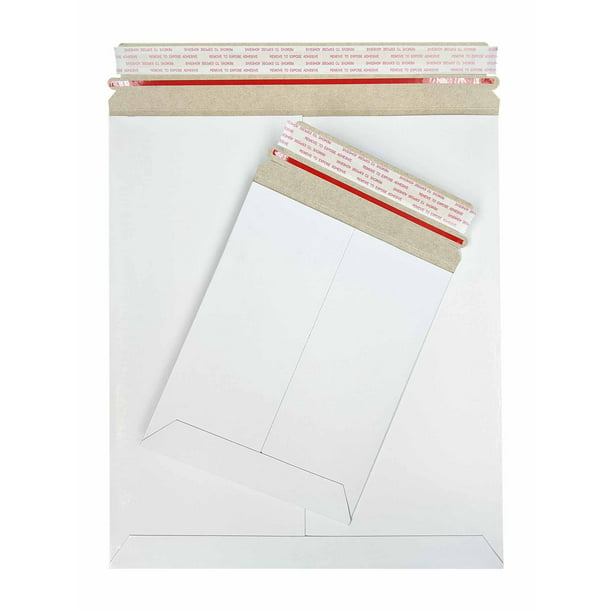
Right now, you need two physical things: mailers and labels. Mailers are cardboard envelopes, basically, which are ideal for shipping zines; labels are the literal pieces of paper you stick to the outside of those mailers. 

For mailers, get the smallest ones you can that'll still fit your zine (usually 9" x 6" or so). For labels, I would buy labels that can be printed on by ordinary printers: you swap out your regular printer paper for label-paper and print away. Both of these can be found at an office supply store (or via Jeff Bezos).

Now you have zines, blank labels, mailers, and a spreadsheet. You still need the actual shipping labels themselves. 

There are lots of places that will sell you labels, but my preferred site is pirateship.com, as they're cheaper than basically anywhere else. Make an account, and then create a new shipment: put in the weight and dimensions of your package (I'd add an extra 10-20% to the weight, just in case), then upload the spreadsheet from Kickstarter. Pirateship will create a whole bunch of shipping labels based on that spreadsheet, which you then pay for and download as a PDF.

Now, take that PDF from Pirateship and print it out on your label paper, one shipping label per half of label-paper (this makes more sense when you see it in-person). Take those now-printed labels and slap 'em onto your mailers, then stuff a zine into each mailer. 

A VERY IMPORTANT NOTE: when you get your labels from Pirateship, make sure to get a SCAN form with them. This is a big receipt that says "here's all the labels this shipment contains." Print the SCAN form with your labels. It's free, there's a button for it, you just have to get it.

Once all your zines are labeled and stuffed into mailers, call your local USPS office: tell them you're planning a large dropoff of [X] zines and that you have a SCAN form. They'll tell you to come around the back or side of the post office, somebody will come meet you, you'll drop off your dozens/hundreds of zines, they'll check the SCAN form once, and you'll be done. 

If you don't do this, dropping off your zines will take literal hours, you'll annoy everyone else, and the USPS staff will hate you. Get a SCAN form. Save the sanity of both yourself and our boys in blue.

But—once you drop off all of your (labeled, mailer'd) zines with a SCAN form, you're done! Congrats! 

STEP 0: BUDGETING

This is where it gets hard. The perennial question is, of course, "What should your KS goal be?" and the eternally-unhelpful answer is "It depends."

My basic piece of advice for budgeting is this: work backwards. Start with the costs that don't move, and build towards the ones that can. 

Here's a step-by-step example.

0A: PRINTING

Printing is, actually, probably the easiest to calculate. DriveThru has a pretty reliable print cost schedule, and Mixam lets you see prices on the fly

As a baseline, assume you're going to print 100 copies. The smallest projects won't quite get there, but it's a good threshold to work from. 

As a baseline, we're going to be making a 36-page black-and-white zine. A Kriegsmesser, say, or a Lay on Hands. On DriveThru, this runs about $1.85/copy, for a total of $185; on Mixam, a 100-copy run goes for about $130.

For reference, a 36-page color (saddle-stitched) zine on DriveThru is about $2.50/copy, for a total of $250; 100 36-page color zines on Mixam is about $250.

0B: SHIPPING

If you're printing with Mixam or locally: Pirateship will let you put in a sample package and then give you rates on the fly, which makes this process a lot more straightforward.

If you're printing with DriveThru: check out the estimated scheduling cost here. Historically it's been pretty accurate for me.

In general, domestic shipping inside the US for a zine will cost between $4 and $5. We're going to round that up to an even $5 for convenience and wiggle room. (It might end up being less, if you get lucky.)

International shipping is way dicier, especially in these global plague-times. This past year, in 2021, international shipping for a zine cost me about $15 per zine, on average. That varied a lot—western Europe is cheaper than most of the world which is cheaper than Australia which is (somehow) cheaper than Canada. It's hard to predict, but $15 is a solid baseline.

If you're not printing with DriveThru, you also have to buy mailers and labels. A 100-pack of mailers is about $30; 200 labels is about $15. We're going to round that up and say that, for mailers and labels, it's about $0.50 a copy—in higher numbers, that cost will drop.

Historically, as a dude writing in English from the States, about 30% of my backers have been international. That varies a bit, obviously, but I suspect that's a pretty reasonable baseline.

If we're printing with Mixam, 70 of our copies will cost about $5.50 each to ship, and 30 of our copies will cost about $15.50 each to ship—a total of (probably) about $850. You also have to pay them to ship the zines to your house (probably around $15), for a total of about $865.

If we're printing with DriveThru, 70 of our copies will cost about $5 each to ship, and 30 of our copies will cost about $15 to ship—a total of (probably) about $800. 

0C: PRODUCTION

Here's some fast math:
  • Layout designers charge around $10/page. That's what I charge, that's what most indie/small-scale designers I know charge. If you're new or it's a really simple project or you have a good friend, it might be lower, but $10/page—which again, gets you very nice layout—is a baseline.
  • Editors charge around $0.06/word for line, copy, and proof edits together, plus ~$25/hour for dev edits. Dev edits happen hourly because they involve, like, reading and suggestions and discussion. All the others happen per-word, based on your manuscript. (In general, for a ZQ project, I would tentatively say that dev edits are less necessary from a hired editor—talk to your friends and colleagues, then pay the editor for line/copy/proof.)
  • Artists vary a lot, but you can generally probably expect to pay around:
    • >$300 for full-page art (that is, 5.5" x 8.5"). The bigger and more complicated, the more expensive.
    • $100–$300 for half-page art (half that)
    • <$100 for spot art
    • If your art's in full color, roughly double all of those
    • These are, obviously, estimates. Really successful professional artists will charge more, but I've hired artists for multiple projects now, and they've generally held around these numbers.
    • Be nice to your artists. Pay them what they're owed. Don't shortchange them.  
The "traditional method" for paying you—the writer—for ZQ is that you get paid whatever the leftover profits are. Typically, this is not a lot. The traditional method is traditional because it's very cheap. 

We're going to assume our 36-page manuscript is around 10,000 words; we could fit more, but let's say we have breathable margins and some nice diagrams and things.

A layout designer will cost us about $360 for layout. Simple.

If we're paying an editor for 8 hours of dev (quite a bit for a project this size) and the full run of edits, that'll come out to around $800. Cutting the dev reduces that to $600. 

For simplicity, let's say we're going to get one piece of cover art ($300), a half-page piece of art ($200), and two pieces of spot art ($100 apiece): call it roughly $700 total. 

For the full monte here, layout and editing and art, production comes out to $1860, round it up to $1900.

Of course, we don't need any of this. We could spend $50 on Affinity to do layout at home, skip dev edits, and spend another $150 on a very simple half-page piece of cover art for a total of $800.

You can go even further—download a bootleg copy of Powerpoint for layout, trade edits with a friend, and use exclusively free and public domain art, for a grand total of $0. Your zine will look, feel, and be cheaper, but hey, zero dollars is zero dollars.

Production is extremely variable.
 
One fast note—its customary that, once the project is done, every contributor to the project gets a copy of the game for free, from you. This is small in the grand scheme of things, but it's worth remembering.

0D: KICKSTARTER'S CUT

On paper, Kickstarter takes 5%. In practice, Kickstarter takes 10%. Assume 10% of your cash is going to Kickstarter.

0E: THE SLUSH FUND

You should set aside another 10% for "oh shit!" moments. They happen. That said, after the campaign ends, you can dip into this when you're coming up short elsewhere. Eat your slush fund before you starting eating your own pockets.

0F: PDFs

This is where the math gets weird: PDFs you sell on Kickstarter are, basically, free money. You still have to pay for production for the PDF, but you don't have to pay for printing and shipping after that. 

How many PDF-only backers will you get? In my experience, about 25% of the total. If you have 150 backers, around 36 of them will be PDF-only. 

But, PDF-only pledge tiers are usually cheaper than print tiers, sometimes significantly so. While in my experience they've made up around 25% of backers, they usually only account for 10-15% of your total funding. It's tricky.

We've arbitrarily decided we're planning to have 100 print backers, so we can equally-arbitrarily decide that we'll have about 32 PDF-only backers on top of them.

0G: SETTING THE TIERS

Tiers, or pledge tiers, or just pledges, are the various levels that backers can give you money in exchange for rewards. Usually, there is a cheap tier for just the PDF and a "standard" tier for PDFs + physical zines. 

(Sometimes, there's an even bigger, more expensive tier that includes fun knick-knacks, like patches or stickers or postcards or jars of bones. I would avoid these for now unless you're very sure about them—they are almost always lots of extra work, headache, and sometimes cost.)

Generally, you need your physical zine tiers to do three things:
  1. Make enough to pay for itself.
  2. Make enough to pay for fixed costs (production)
  3. Not be significantly outside the expected realm of costs for these kinds of things.
Generally, speaking, most physical zine tiers for ZQ cost between $10-15. Any higher than that and you'll need to prove that you've got something real fancy to show off (like absurd production quality or a huge team or something).

Does this $10-15 track hit all three? Sort-of yes. It definitely hits #3 and #1. #2 is variable based on your production costs.

PDFs are usually about half of whatever the physical tier was; $5–$7 PDFs are standard. You could probably nudge it higher to try to raise more (but you might lose backers) or lower to try to get backers (but you might make less overall). As I said, PDFs are basically free money from your side, so the stakes are low—half the cost of the physical is a good baseline.

0H: PLEDGE TIERS' SHIPPING

On Kickstarter, you can attach shipping costs to a tier. Not only that, you can attach shipping costs to a tier based on the individual countries / parts of the world you're shipping to (so the US could be $5, $12 to the UK, and so on.) This is very handy, since it lets you modulate the amount people have to pledge for shipping.

Critically, these shipping costs are added onto the pledge, and thus to the total funds raised of the Kickstarter itself. If you have a $12 basic tier with another $5 added on for shipping, $17 gets added to the total funds raised on Kickstarter. If you have razor margins on your total Kickstarter amount, this matters a lot.

Let's do some math.

We're going to charge $12/copy for our (36 pg, B&W) zines, plus $5 for US backers and $15 for international backers (you might ratchet shipping costs up by a dollar or two, just in case).

Assuming all of our shipping funding gets eaten (it will), we're paying about $2 per copy, leaving us with a net $10 per physical tier. If we're sticking with our 100 print backers, that's an even grand; add on 32-odd $6 PDF-only tiers, and we have about $1200 to work with. 

Some of that $1200 is earmarked: 10% of the total goes to Kickstarter ($1050), another 10% goes to the slush fund ($900).

This remaining $900 is for two things:
  1. Paying your artists, editors, and layout designers
  2. Paying yourself
Both of these matter.

0I: GAMBLING AND/OR INVESTING

Making a Kickstarter page is free; launching a campaign is free. 

That said, I would broadly recommend that you front some of your own cash ahead of time to buy art. Every time that I've commissioned art for a KS project ahead of time, it has paid off many times over. In general, I would recommend that this is your cover art: make it the cover of your zine and the thumbnail on your KS page, to link the two together. Good art catches eyeballs and opens wallets.

This means, essentially, that you're gambling with several hundred dollars of your own money that your Kickstarter will succeed. If you have a full-time job, a $300 bet is not out of the question; if you're a mostly-broke grad student (like me), a $300 bet is serious.

Like I said, though, every time I've invested in for a Kickstarter campaign's page, it's paid off. My lowest-funded and least-successful Kickstarter projects were the ones with little art or crummy art. 

0J: SO HOW MUCH SHOULD YOUR CAMPAIGN GOAL BE?

The short answer is: enough to pay off any investments you've already made. 

Because of the way shipping and PDF tiers work on Kickstarter, there's no way to guarantee this number, unfortunately. But, using data, you can make some reasonable assumptions.

Let's say you've sunk $300 into art for the campaign page, so you need, at bare minimum, $300 in profits from the campaign. This assumes you're spending $0 on layout, editing, and your own time & effort.

Time for some weird projection math based on averages:

Each $12 pledge:
  • Adds about $9 in funding you can use to your pockets
    • +$12 pledge
    • +$2, for 33% of a $6 PDF pledge 
    • -$2, for printing
    • -$1.50, for Kickstarter
    • -$1.50, for the slush fund
  • Adds an average of about $22.5 to your campaign total
    • +$12 pledge
    • +$8.5 shipping (average of $5 US + 30% of $10 for international)
    • + $2, for 33% of a $6 PDF pledge
This means that if you need $300 for art-debt, you need a pledge goal of roughly $750 ([300 / 8.75] * 22) in order to not go under. The rough hypothetical breakdown here would be:
  • 25 physical zines, US (each kicking in $17)
  • 10 physical zines, international (each kicking in an average of $27, varying by country)
  • 10 PDF backers (each kicking in $6)
As a worst/best case scenario, imagine you get 125 PDF backers and nobody else: you make $300 in profit (post slush-fund and KS's take) and have to produce zero zines. Alternatively, imagine you get 28 international backers and no one else: you make $235 in cash, leaving you technically "funded" but actually still $65 in the hole. Neither of these will happen, but this kind of hypothetical math is worth thinking about.

If we hit the long-assumed 100 physical backers and all these math averages hold steady, you'll have about $900 for paying off art-debt, production, and your own wallet; your campaign will have raised $2200—a very respectable amount for a first time Kickstarter project. 

(I think this math all checks out. Please let me know if it doesn't.)

You can see how, if you're paying for plenty of art and layout and editing ahead of time, Kickstarter goals skyrocket hugely despite the projects themselves not actually having all that much actual cash to work with (see NERVES and A Catalogue Chimerical as two examples of these kinds of high-upfront-goal projects). That's a risky play—projects with relatively high goals compared to others are much less likely to get funded.

Of course, if you do everything yourself and spend $0 before the campaign, you can make your goal whatever you want—think about how much money you want to take home at the end of this. If you don't care about the money (but you should), set your goal somewhere between $500 and $1000. 

So what if you do want fancy art and editing and layout and everything? If you have such variable margins on everything, how can you ever be sure?

0K: STRETCH GOALS

There are, in my mind, three basic kinds of stretch goals:
  1. Creative stretch goals that are more work for you but have relatively low costs otherwise: extra pages, more content, more stuff in the book. These are... fine. They're fine. Do them if you want, but I'd advise keeping a very tight leash on new content, and write as much of it as you can ahead of time.
  2. Creative stretch goals that are more work for you and also have high costs otherwise: pamphlets, inserts, pocketmods, more zines, stickers, postcards, dice, the dreaded shirts. Avoid these. They're bad. They eat all your time and money.
  3. Non-creative stretch goals that cost money but relatively little time: higher production values, essentially: more art, more editing, more layout, snazzier zines, and so on. These ones are good: they make your book better and you can tightly control for them ahead of time.
My broad-spectrum advice for ZQ is that, if you really want snazzy editing and layout and art, make them stretch goals. Calculate how much the new stuff will cost you (you can do it on paper ahead of time, but also just talk to the people you want to hire), then make it a stretch goal. If you hit those goals, perfect; if you don't, well, at least you're not in the hole.

Calculate your stretch goal costs carefully. Add lots and lots of padding. Remember, every time you pay an artist/editor/designer/whoever for new stretch goal stuff, you're taking away the money that could instead be going into your own pockets. 

I would strongly advise against stretch goals like #2. I've added pamphlets and inserts and shit into my ZQ projects, and they eat up tons of time and money. Avoid them. 

--

Okay. That's budgeting. If you're still here, good job.

STEP 6: AFTER KICKSTARTER

You made your budget, you ran the campaign, you made the zine, you printed them out, you shipped them out to all your backers. Now what?

First, put the PDFs of your zine up for sale on itch.io and DriveThruRPG. These are the two major PDF marketplaces for RPGs, you want people buying them there. Post about them when they go live.

If you printed with DriveThruRPG, you should make your zine available for sale to the public through print-on-demand. Then, you're done. People will buy your RPG, and you'll make money in your sleep.

If you printed locally or via Mixam, you have a choice. You can:
  1. Print enough copies to send them out to your backers, friends, and family. 
  2. Print some extra copies to sell to online retailers.
Option #1 is pretty straightforward: you make money off the KS, and anybody in the future who wants your game has to settle for a PDF.

6A: SELLING COPIES TO RETAILERS

Option #2 is a little trickier. This is another gamble: you're printing off extra copies, once that haven't already been paid for, in the hope that you can sell them later to make more money. 

Here's how this works:
  1. You've sent out all your Kickstarter copies, and now have a box or three of zines left over, sitting in your closet.
  2. You contact online retailers (see the list below) and tell them you have a zine you'd like to sell, and why it's cool.
  3. They purchase some amount of copies (probably 5–15 or so) from you at wholesale prices.
  4. You box up those copies, walk them down to the post office, and mail them to the retailer. (Retailers pay for shipping.)
  5. The retailer sells them on their store.
  6. Go back to #2, rinse and repeat.
Wholesale price, usually, is 50% of normal price. If your zine is $12, wholesale would be $6. If a retailer buys 10 copies at wholesale, you make $60 profit.

The advantage to this is that you get to keep making money after your Kickstarter ends—if your zine is really popular, you might actually make hundreds or thousands of dollars. 

The disadvantage is that, every once in a while, you have to message people asking if they want your game, box up a bunch of zines, and walk them down to the post office. Not an insurmountable challenge by any means, but it does mean you can't ever 100% stop thinking about the game. 

How many extra copies should you order? There's no one single right answer, but my broad advice is about half(ish) as many as you had physical backers for during the campaign, with a floor of about 100. If you had 100 backers during the campaign, I'd order another 100. If you had 300 backers during the campaign, I'd order another 150-ish copies to sell to retail. 

If it turns out your zine is wildly popular after the campaign and you run out of all your extra copies, congrats! You get to do a second print run—a rare achievement in RPG circles.

6B: SOME ONLINE RETAILERS 

This is by no means a comprehensive list, but here are some online retailers who may or may not be interested in stocking copies of your game:
No guarantees these folks will for certain want your stuff, but they're worth reaching out to. They all have contact emails, lots of them you can find on Discord or Twitter, too.

THE EXECUTIVE SUMMARY

Here's how to do ZineQuest:
  1. You need an RPG. It can be almost anything in terms of content, but must be generally zine-sized.
  2. You need a Kickstarter page. Tell us: 
    1. What your game is. 
    2. Why it's cool. 
    3. What they get. 
    4. Who you are. 
    5. If there are any stretch goals.
    6. I recommend paying a bit of money for nicer art ahead of time; it usually pays off.
  3. You need to produce the zine. There are four parts to this:
    1. Writing. This is probably what you do.
    2. Editing. This makes the writing better, and costs $0.06/word, usually.
    3. Art. This is pretty; big art costs >$300, medium art costs $100–$300, small art costs <$100.
    4. Layout. This makes the book pretty, and costs $10/page, usually.
  4. You need to print the zine.
    1. If you print on DriveThru, it's way easier but they give you shittier books. 
    2. If you print on Mixam, you have to ship it yourself, but they give you nicer books.
    3. These generally cost about the same; Mixam gets cheaper with more copies.
  5. You need to ship the zine.
    1. If you print on DriveThru, you pay them $5 domestic and ~$15 international and they handle it.
    2. If you print on Mixam, you need to pay $5 domestic and ~$15 international, plus $0.50 for labels and mailers. 
    3. Pay for your labels on Pirateship, then print them and stick them on your mailers. Make sure you get a SCAN form before you drop everything off at the post office.
  6. You need to pay for everything.
    1. Most zines are $10–15 on KS. Most PDFs are half that.
    2. Remember shipping gets added to your totals.
    3. Set your goal so that you can break even on any money you spent ahead of time.
    4. Use tactically-calculated stretch goals to pay for more art, editing, and layout.
  7. After the Kickstarter ends, you can still make money.
    1. If you printed on DriveThru, enable your zine for sale and you're done.
    2. If you printed on Mixam, you can sell your zines to online retailers.
    3. They buy a handful of copies at a time at wholesale price (50%) directly from you, then sell them on their stores.

--

Okay. I think that's everything. 

I hope this has been helpful, thank you for sitting through such a beast of a post.

Feel free to share this wherever you want; if you have your own suggestions or ideas, please leave them in the comments.

If you have questions, you can always find me on Twitter at @HeadOfTheGoat, or on Discord at SquigBoss#1353. If you need an editor or layout designer, I'm available for work.

I look forward to seeing your zines!

Tuesday, October 12, 2021

Language for Wizards

This is a pretty half-baked one, sort of a corollary to my last post. Partial inspiration from Vayra and Arnold.

THE COMMON TONGUE

Is bullshit. There should be lots of different human languages in your setting. A singular "common tongue" is total bullshit, meant to smooth over difficult worldbuilding and actually challenging social encounters. 

There are about 8 billion people on the earth, and there are about 6,500 languages spoken, some of which by very few people. Even if with 100 times fewer, with a mere 65 languages, that's still about 64 more languages than are commonly spoken by humans in your average D&D game. 

(There's an argument that the common tongue is "fantasy Esperanto" or "fantasy Ithkuil," which is a very cool idea that I would love to see developed but thus far haven't, really.)

Point is, there are lots of lots of languages, and all of them are normal to somebody. That's not what this post is about. Merchants and couriers and diplomats will learn lots and lots of languages here in D&D-fantasyland, but those are all human languages.

THE LANGUAGES OF THINGS

Things can speak. This is known. 

On midwinter's eve and the heydays of high summer, when the traveling fairs and circuses and fair folk come into town, there can be sometimes found an elder traveling with them who speaks one of the old tongues. Perhaps run the riddling-contest, or they are the teller-of-tales, or they a watchful impresario. No matter which way, they will occasionally murmur words in those strange tongues, and send shivers down your spine.

What makes a wizard a wizard is their ability to speak to things that normal people can't. This is sorcery, witchcraft, uncanniness—speaking to things that shouldn't talk and then having them reply.

Things can speak. This is known. 

SOME OF THE OLD TONGUES

1. SYLVAN
The language of trees, and woods, and ancient gnarled things.
Spoken by elves, faeries, elk, wolves, crows, pines, oaks, elms, roots, vines, creepers, fallen leaves, and acorns.
Wizards who speak sylvan are often called druids, witches, or greenseers.

2. PHLOGISTON
The language of fire, and heat, and roiling changing things.
Spoken by phoenixes, dragons, djinn, salamanders, fireflies, fire, ash, charcoal, dead wood, stews, smelters, and summer haze.
Wizards who speak phlogiston are often called sorcerers, pyromancers, or conjurers.

3. TERRA
The language of stone, and earth, and hard unmoving things.
Spoken by dwarves, giants, trolls, worms, moles, rock, stone, clay, shale, brick, iron, hammers, armor, ancient crusty bread, etched stone runes & glyphs, and cellars.
Wizards who speak terra are often called hermits, geomancers, or runecarvers.

4. RUIN
The language of rot, and age, and decrepit dead things.
Spoken by ghouls, zombies, bones, carcasses, carrion, roadkill, tombstones, coffins, dead trees, ancient ruins, vacant houses, mildewing books, spoilt food, plagues, anything preserved in ominous fluids, and chrysanthemums.
Wizards who speak ruin are often called necromancers, haruspices, or heretical priests.

5. VIA
The language of roads, and bridges, and long traveling things.
Spoken by horses, mules, ponies, wagons, carts, wheels, way-signs and -stones, roads, bridges, cobblestones, inns, rivers, backpacks, and certain generous stars.
Wizards who speak via are often called mendicants, wanderers, or sages.

6. DEEP
The language of caverns, and the sea, and ancient hidden things.
Spoken by mind flayers, squids, octopi, crabs, the ocean depths, stalactites, stalagmites, limestone, elder gods, caverns, anything petrified, pale blind wriggling things, fear, caverns, pits so far you cannot see the bottom, and whale-bone.
Wizards who speak deep are often called warlocks, occultists, or esoterics.

There are obviously many more old tongues: the language of mirrors and eyes, the language of cities and machines, the language of secrets and murder, the language of coins and laws, the language of blood and heart, the language of wind and thunder, and many, many more. These are just the ones I came up with sitting at my machine here and now.

LEARNING THE LANGUAGE

There are a lot of ways you could approach this. Some languages are taught from master to apprentice, some via a huge collection of dusty tomes, some by divine blessing, some by living far from humans for many years, and some by having some otherworldly thing touch your brain.

Books that contain these languages are very, very dangerous. Those are books that turn ordinary people into wizards.

I'd probably seed these throughout my game world, let players chase after them. Maybe, instead of being a highborn noble or a trained soldier or a devout priest as a starting character, you're somebody who happens to know one of these languages.

USING THE LANGUAGE

I can talk to you and, with the right words, make you do things. 
  • Here's $100 for your new book.
  • Take me out to dinner and I might give you a kiss.
  • Give me all the money in the bag, or I pull the trigger.
The old tongues operate by the same measures: you offer something, and they'll do something for you. Difference is, dead bones and wolves and wagon-wheels and ancient caves all have very different desires; some achievable, some not.

Part of what distinguishes one wizard from another is which languages they speak, yes, but what really distinguishes a good wizard from bad is how they use the languages they know. 

And, obviously, what they do with that knowledge, now that they have it.

Monday, July 26, 2021

Wisdom for Wizards

Hot Take: Wizards' power should scale more from Wisdom than Intelligence. 

Maybe. I'm not 100% convinced. But given the historical tradition of the clergy as the educated, monastic, institutional class and sorcerers as the mysterious, outcast, freak class, I'm inclined to base Clerics on Intelligence, and Wizards on Wisdom. There's decent arguments against this (and really it should scale off of both but that's a level of crunch nobody wants to deal with), but we're going to roll with it.

--

Anybody can cast a spell. It takes time and knowledge and effort and you might mess it up, sure, and those who carry around ancient tomes full of spells might well be wizards, but merely spellcasting does not a wizard make.

What makes a wizard? Secrets. Insight. Perceiving reality as others do not. Seeing that which others cannot. Wisdom.

With that in mind, here is Wisdom for Wizards:

10 Wisdom
You are as perceptive and observant as an ordinary person. You know that which an ordinary person would.

11 Wisdom
You can always remember your dreams.

12 Wisdom
You know when you perceive a lie, be it written or spoken. When you meet someone, you instinctively know one secret about them.

13 Wisdom
You can speak the secret language of birds; if properly bribed and persuaded, you may be able to recruit spies.

14 Wisdom
You can see through illusions, and can see invisible things.

15 Wisdom
You can see ghosts, faeries, demons, angels, and spirits. Each of those—whether others can see them or not—will sometimes tell you things they wouldn't others.

You can also see DEATH. When you die, he'll come to collect you personally.

16 Wisdom
You can read all written text, no matter its language or script. You know the secret language of runes.

17 Wisdom
You can see the true forms of shapeshifters and the disguised. If they have multiple forms, you can see one form in your left eye and one in your right.

18 Wisdom
If looking through a mirror or lens, you can see and speak into other planes of existence, like Hell or Fairyland; assuming there's someone there, they can see you and reply in turn. 

19 Wisdom
You can see into the future. If you keep your eyes closed for more than a minute, you will start to see fragments and snatches of what will, inevitably, happen to you. The visions may be unclear, but they are always accurate.

20 Wisdom
Any question you perceive—through sight or sound or another force entirely—you know the full and complete answer to, whether you want to or not. 

There maybe should be some hits to your CHA or INT to go with this, but whatever it's fine. 

--


It's etymologically sound, nerds.